How to Get Paid Making AI Short Dramas | StoReel Canvas
Learn how to get paid making AI short dramas: compare payout models, estimate costs and break-even, and check contract terms first.

How to Get Paid Making AI Short Dramas in 2026: Payouts, Costs and Risks
Creators get paid for AI short dramas through fixed-fee production contracts, licensing deals, revenue sharing, episode unlocks, ad revenue and brand integrations. No source we reviewed shows a verified typical income, so check contract terms and run your own break-even math before producing a series. StoReel Canvas gives you the production workflow and a Paid Projects marketplace.
Ready to produce your first series? Build the script, storyboard, voice and video in one workflow.
Create your StoReel Canvas account
Last updated: 2026-11-19
Key takeaways
Creators can be paid in six main ways: fixed fees, licensing, revenue share, episode unlocks, ads and brand deals.
Verified public payout data is scarce. Treat every earnings figure without a named source, payment type and date as an assumption.
Low AI production costs do not guarantee profit. Labor, retries and audience building all count.
Calculate break-even before you produce a full series, and validate the deal first.
Paid Projects on StoReel Canvas is one route to paid work, with requirements and compensation shown per listing.
Can you really make money making AI short dramas?
Creators can be paid for AI short dramas, but no public source we reviewed proves what a typical creator earns. Treat any income figure as an assumption until it comes with a named source, a payment type and a date.
What does the available evidence show?
Community discussions show creators asking whether anyone has actually been paid. Many guides publish revenue scenarios built on assumed views, conversion rates and platform cuts. Neither is verified payout data.
Verified payouts vs. anecdotes vs. projections
Evidence type | What it is | How to treat it |
Documented payout | A contract, statement or payment record | Strongest evidence. Check what was paid for and whether it was gross or net |
Creator report | A first-person claim without documents | Useful signal, not proof |
Platform statement | Terms published by the platform | Check the official page and its date |
Projection | A calculation from assumed inputs | An example only, not an earnings rate |
Why low production cost does not guarantee profit
AI tools lower the cost of making episodes, but profit depends on more than tool cost. Unpaid labor, failed pilots, wasted generation credits, audience acquisition, rejected submissions and rights disputes all reduce what you keep.
How do AI short drama creators get paid?
Creators are paid through six main routes. Which ones are open to you depends on the platform or client.
Route | How you earn | Main risk | Ask before you start |
Fixed-fee production contract | A client pays an agreed amount to produce content to a brief | Extra revision rounds and scope creep | Deliverables, number of revisions, payment dates, acceptance criteria |
Licensing fee | A buyer pays to license a finished series or script | Broad or exclusive rights | Which rights, how long, which territories, exclusivity |
Revenue share | You receive a percentage of the revenue the series generates | Payments that are hard to verify | How net revenue is defined, reporting frequency, audit rights |
Episode unlocks | Viewers pay to unlock episodes | Needs a paying audience | Who sets prices, the platform's cut, payout threshold |
Ad revenue on short-form platforms | Ads run against your videos | Earnings depend on views and eligibility | Monetization eligibility and payout rules on the official page |
Brand integrations | A brand pays for placement or sponsorship in your episodes | Needs an audience and negotiation | Disclosure rules, usage rights, exclusivity |
Where can you publish or pitch an AI short drama?
You can publish or pitch to dedicated short drama apps, short-form social platforms, commissioned-work marketplaces or your own channels. Each route has different eligibility and payout rules, so verify them before you produce.
Route | Examples | What to verify |
Dedicated short drama apps | ReelShort, DramaBox, DramaWave (apps creators ask about in community discussions) | Whether independent submissions are accepted, AI content rules, deal types, evidence of payouts |
Short-form social platforms | TikTok, Instagram Reels, YouTube Shorts | Monetization eligibility, ad payout rules, content policies for AI-generated video |
Commissioned work | StoReel Canvas Paid Projects | Each listing's requirements, compensation and usage terms |
Your own channels | Your site, your community | Audience acquisition cost. No platform payout |
If a detail is not published in writing, treat it as unknown, not as a yes.
Want to test an idea before committing to a full series? Start with a short script and a storyboard.
Start your first AI short drama
Or browse AI short drama templates to see how others structure a series.
How do episode unlocks and revenue sharing work?
With episode unlocks, viewers pay to open episodes beyond the free ones. With revenue sharing, you receive an agreed percentage of the revenue your series generates. Both depend on how the platform defines and reports revenue.
Before you agree to either model, get these answers in writing:
How the platform defines net revenue and which deductions apply
How often revenue is reported and paid
Whether you can check the figures
Whether a minimum guarantee exists
Which rights you give up while the deal runs
Percentages differ by platform and deal. Use only figures from the official terms or your own contract.
How do you create your first AI short drama?
You create an AI short drama by writing a script, turning it into a storyboard, keeping characters consistent, generating video and voice, then editing for pacing and quality. A StoReel Canvas workflow covers these stages in one place.
Write the script and series outline. Keep the first episode short and end it on a hook. The AI short drama generator turns a script into a finished vertical drama.
Build the storyboard. Use an AI storyboard generator to turn the script into frames before you spend generation credits on video.
Keep characters consistent. A character consistency tool keeps the same face, outfit and style across scenes.
Generate the video. An AI script to video workflow turns your script into a draft video.
Review and edit. Check pacing, cliffhangers and quality before you submit or publish.
How much does it cost to make an AI short drama?
The total cost is more than the tool subscription. It includes generation credits, retries, voice, editing, your own time and distribution. Costs depend on episode count, episode length, quality target and how many retries you need.
Cost line | What drives it |
AI tools and generation credits | Number of episodes, length, retries |
Script and story development | Your time or a writer's fee |
Voice, music and sound | Tools or licensing |
Editing and quality control | Number of review passes |
Labor | Hours multiplied by your hourly rate |
Distribution and audience | Promotion, community time, ads |
Add every line before you compare cost with expected revenue.
Want to see how much of this one workflow can cover?
Try the StoReel Canvas workflow
How do you calculate break-even and realistic earnings?
Break-even is the point where your revenue equals your total cost. Calculate it with your own inputs and label each one as observed or assumed.
Total cost = tools + labor + voice and music + editing + distribution
Net revenue per unit = gross revenue per unit − platform cut − other deductions. A unit can be a paying viewer, an unlock or a thousand views.
Fixed-fee deal: profit = fee − total cost
Revenue share or unlocks: break-even units = total cost ÷ net revenue per unit
Run a low, a middle and a high scenario by changing the number of units and the net revenue per unit. These results are planning estimates, not earnings guarantees.
How can you validate the opportunity before producing a full series?
Validate the deal before you produce, not after. Follow these steps and stop at any point where the evidence does not support more investment.
Read the platform's or client's creator terms and submission rules.
Estimate your total cost and the possible return with the formulas above.
Make a short pilot or script sample instead of a full season.
Test audience response where you can.
Decide whether to scale, revise or stop.
What contract and copyright risks should you check?
Check how payments are reported, which rights you grant, and what happens if the platform rejects or ends the deal. Get the answers in writing.
Payment transparency: how revenue is reported and whether you can verify it
Exclusivity and ownership: which rights the buyer gets and for how long
Rejection and termination: what happens to your work and payments if the deal ends
AI content rules: whether the platform accepts AI-generated content and under what conditions
Payment schedule: payment dates, thresholds and currency
How do Paid Projects work on StoReel Canvas?
Paid Projects is a marketplace on the StoReel Canvas platform where creators can work on listed projects for pay. Each listing shows its own requirements and compensation, so terms differ from project to project.
How to browse and apply
Open the Paid Projects list and review the current projects.
Open a listing and read the full requirements, schedule and compensation information.
Check that you meet the requirements and can meet the deadline.
Follow the application instructions in the listing.
Before you start production, confirm the scope, deliverables, payment terms and content-usage terms for that project.
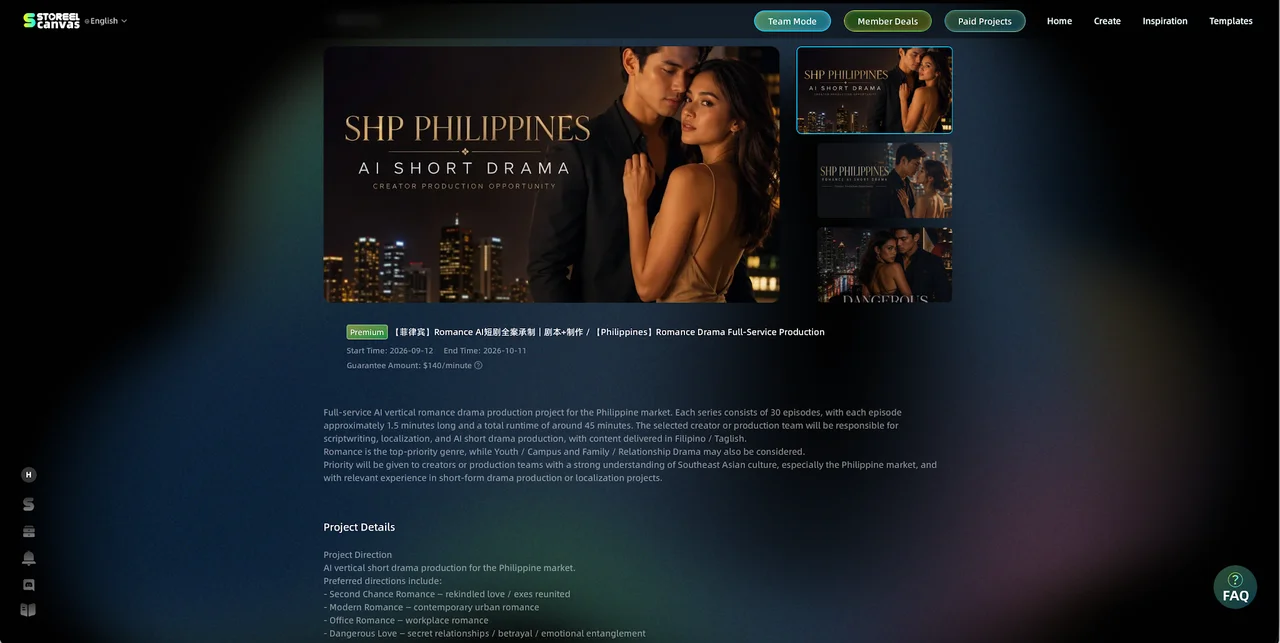
How are Paid Project earnings determined?
Paid Projects do not use one universal rate. Compensation varies by project, so use the listing as your starting point.
Before you begin production, confirm:
Total compensation or the applicable rate
Which deliverables are included
How accepted work is measured
Whether revisions are included
Payment timing, method and currency
Any tax, invoicing or transfer requirements
Want to see what is open now? Browse current projects and compare their requirements.
You can also get ideas in the StoReel Canvas community.
Frequently asked questions
How do you get paid making AI short dramas?
Creators are paid through fixed-fee production contracts, licensing deals, revenue sharing, episode unlocks, ad revenue on short-form platforms, and brand integrations. Which route is available depends on the platform or client. Read the contract first, and confirm how payment is calculated, reported and scheduled before you produce a full series.
Can you actually make money making AI short dramas?
Some creators may be paid, but there is no verified public data showing what a typical creator earns. Community discussions are mostly anecdotal, and published revenue scenarios rely on assumed inputs. Check the payment terms of each opportunity and calculate your own break-even point before investing time or generation credits.
Do short drama apps pay creators directly?
It depends on the app and the deal. Some apps may license a finished series, pay a fixed production fee, or share revenue, and some may not accept independent submissions at all. Check each app's official creator terms, and treat any detail you cannot find in writing as unconfirmed.
Is a fixed fee better than revenue sharing?
A fixed fee gives you a known payment for known work, so profit depends on keeping your costs below the fee. Revenue sharing can pay more if the series performs, but results are uncertain and hard to verify. Compare the fee with your break-even cost, and ask how net revenue is reported.
How much does it cost to make an AI short drama?
There is no single price. Cost depends on episode count, episode length, quality target, generation retries, voice and editing, and your own working time. A tool subscription is only one part. Add every cost line, including labor and distribution, before comparing it with expected revenue.
Can you earn money from AI short dramas on YouTube Shorts or TikTok?
Possibly, if you meet each platform's monetization eligibility rules and your videos reach enough viewers. Ad revenue depends on views, and requirements differ by platform and region. Read the official monetization terms and content policies for AI-generated video before you rely on social platforms as an income source.
How do Paid Projects work on StoReel Canvas?
Paid Projects is a marketplace on StoReel Canvas where creators can work on listed projects for pay. Each listing shows its own requirements and compensation, and rates vary by project. Read the full listing before you apply, and confirm scope, deliverables, payment terms and content-usage terms before you start production.
Not ready yet? Join the StoReel Canvas Discord to ask questions and share your work.
Ready to turn your script into a series? Create an account and build your first episode with script, storyboard, voice and video in one workflow.
Create your StoReel Canvas account